
Heard about trailing stop loss for the first time, but all the explanations sound too advanced? You’re in the right place. This article assumes little to no trading experience.
With help from our in-house trading coaches, we put together a simple guide to help you grasp the basics of trailing stop loss. No trailing stop loss strategy advice here, just a clear explanation of how it works, so you can build a solid foundation.
If you want to practice and learn trading in a risk-free environment, you can try the Finelo app.

What Is a Trailing Stop vs. a Stop Loss
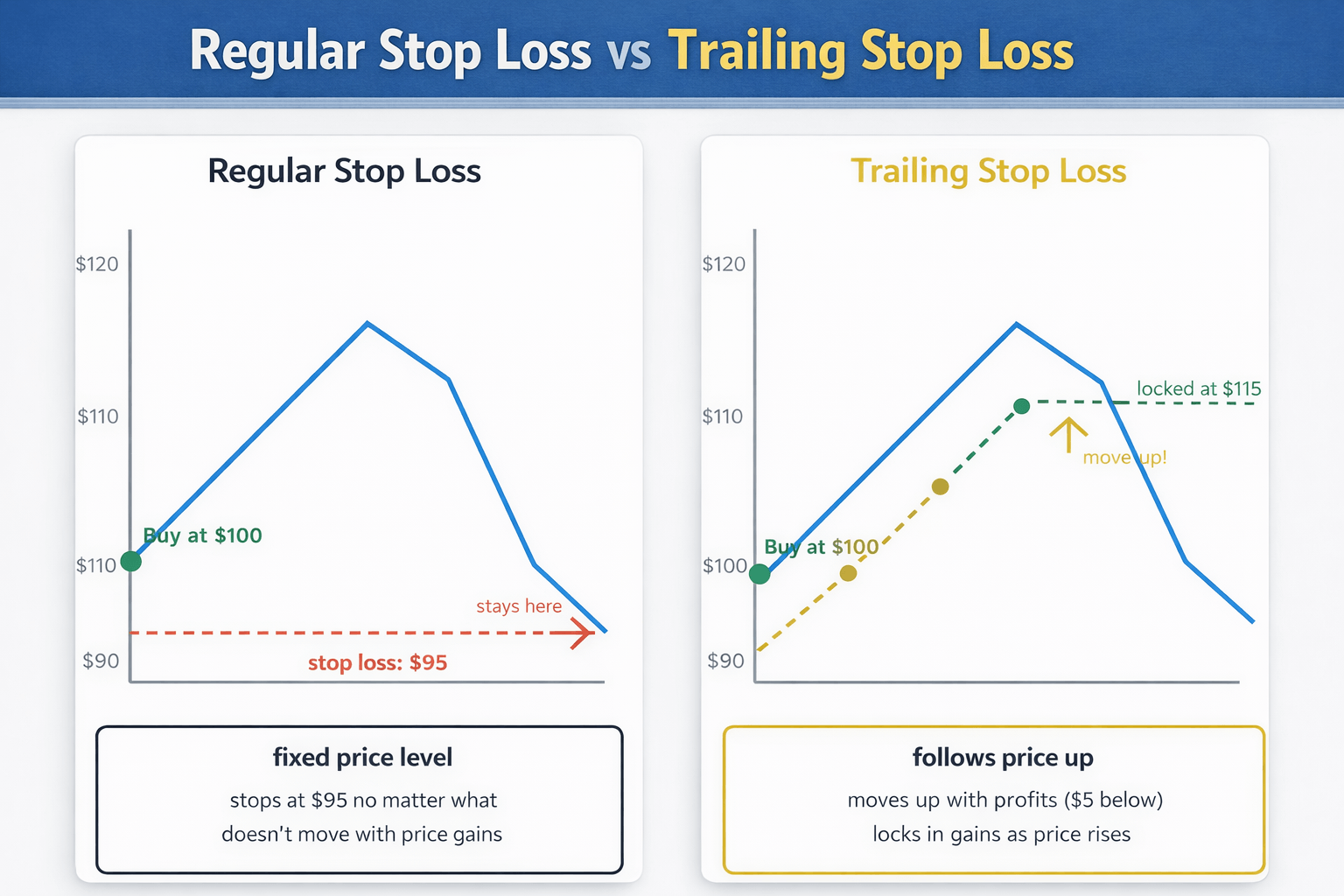
A stop loss is an order type where you tell your investment app to automatically sell your position (e.g., stock, ETF) if the price moves against you and hits the level you’ve set. For example:
You buy something for $100.
You set a stop loss at $90.
This protects you from taking a bigger loss if the price keeps dropping.
Trailing stop loss works a bit differently. Instead of setting a fixed level, it follows the price upward and only triggers a sale if the price falls by a set amount from its peak.
Note: A trailing stop moves only upward and never downward.
Trailing stop order example
You buy something for $100.
Set a trailing distance at $10.
What happens:
- price at $100 → stop at $90
- price at $120 → stop moves to $110
- price at $150 → stop moves to $140
So this order protects your profit, not just loss.
Important note: any stop loss triggers as a market order. That means it sells at whatever price buyers are offering when your stop loss activates, so the final price may be lower or higher than expected.
For example:
- You buy something for $100.
- You set the trailing stop loss at $10.
- Your position reaches $150, and the trailing stop level moves up to 140.
- Suddenly, the price drops fast from 141 to 135.
- The system automatically sets your position to sell, and you exit at around $135–138, depending on speed and liquidity.
How Trailing Stop Loss Works (Step-by-Step Example)
Here’s a more detailed look at how a trailing stop loss order works.
You buy 1 share at $200 and set a 15% trailing stop loss.
- You place a 15% trailing stop.
Right after you buy, the app sets your first safety level.
15% below $200 is $170.
If the price drops straight to $170, your share will be sold automatically. - The price rises to $230.
Your trailing stop moves up on its own.
It now sits at $195.50.
You did not change anything. The app did this for you. - The price continues to rise and reaches $260.
Your trailing stop follows and moves up again.
It now stands at $221.
This highest price is what the trailing stop uses to recalculate. - The price drops from $260 to $240.
Your trailing stop does not move down.
It stays fixed at $221. - If the price falls to $221, the trailing stop triggers.
Your share is sold automatically at the next available market price.
This helps you lock in most of your profit.
When to Use vs When NOT to Use a Trailing Stop Loss
Here’s a disclaimer on when this tool can be useful and when it isn’t a good fit.
When to use a trailing stop order
Strong trending markets. Trailing stops are most effective in markets with clear upward or downward momentum. They let you “surf the wave” of a trend without trying to predict a specific top or bottom.
Trend following and momentum trading. If your strategy focuses on capturing large market moves, a trailing stop helps you hold winning positions as long as the market doesn’t reverse significantly.
When NOT to use a trailing stop loss
Sideways or choppy markets. In markets where the price doesn’t really go anywhere, but just moves up and down in a narrow range, trailing stops can be frustrating.
Each small dip can trigger the trailing stop, even though the overall situation hasn’t truly changed. This means you can get taken out of a trade not because you were wrong, but because the market was just noisy.
Long-term fundamental investing. Many experts argue that stop losses can hurt long-term investors. If you bought a stock because it was a good deal at $50, a 20% drop to $40 makes it an even better deal. A trailing stop would force you to sell at the point where, in theory, you should be buying more.
Before the new market structure forms. Before the market shows a clear new direction, it’s often better to leave the stop loss where it is. If you move it up too early just because you see some profit, normal price pullbacks can trigger it. You exit the trade even though nothing is actually wrong.
Trailing Stop Loss Risks
Here are the trailing stop loss risks to be aware of. These are normal factors that are outside your control.
- Market maker interference. In very liquid markets, large players can often guess where many people place stop losses. When prices briefly move toward those common levels, some stop losses may trigger and close trades early.
- Big overnight price jumps can skip your stop. If bad news appears while the market is closed, the price can open much lower the next day. Your trailing stop still sells, but only at the opening price. This can mean a larger loss or a much smaller profit than planned.
- You will always give back some profit. A trailing stop never exits at the top. By design, it sells after the price turns. That means you always give back part of the highest profit you saw on the screen.
- You may not get the exact price you expect. When a trailing stop triggers, the app sells at the next available price. In fast or jumpy markets, the final sell price can be noticeably worse than the trailing level.
- Technical glitches. While rare, broker platforms or market systems can experience issues that affect stop order execution.
Trailing Stop Loss by Dollar Amount vs Percentage: Which to Use?
Before we move on to setting up a trailing stop loss in your investment account, let’s figure out whether you should choose a trailing distance by dollar amount or percentage.
The percentage is better for beginners. A percentage trailing stop adjusts itself as the price grows. That means it gives the trade more room as it becomes bigger.
A dollar trailing stop always stays the same distance away. It means the stop doesn’t adapt to volatility and can exit even when nothing is wrong.
What Trailing Stop Loss Percentage Should You Use?
Though there is no universal number, the short answer: start with a 10–15% trailing stop. This range works reasonably well for many common situations.
Faster, more volatile stocks (for example, tech or growth stocks) often need 20% or more to avoid early exits.
Tight stops at 2-5% are risky and used by active traders who:
- Trade very short time frames
- Watch the market closely
- Enter and exit with high precision
- Accept being wrong often
To find your own "sweet spot," experts suggest backtesting. It means testing different percentages against historical data for the asset you are trading to see which setting would have yielded the most profitable results.
Conclusion
A trailing stop loss helps you lock in profits automatically as the price moves up, without watching the market all the time. It’s simple, but it has limits: it won’t exit at the top, and normal price swings can trigger it.
If you’re still building confidence, that’s okay. The best way to learn is by practicing without risk.
Try the Finelo app to explore trading in a safe environment and see how trailing stops work in real scenarios.